
Local SEO is the process of helping a business appear when nearby customers search for its products or services in Google Search, Google Maps, and other local discovery platforms. It still works in 2026, but success now depends on more than adding location keywords. Businesses need accurate listings, strong local pages, customer reviews, authority, and a clear strategy for converting visibility into leads and sales.
Local SEO at a Glance
| Best for | Businesses serving customers in specific cities, neighborhoods, or service areas |
|---|---|
| Main results | Google Maps, the local pack, and localized organic search results |
| Main signals | Relevance, distance, and prominence |
| Typical outcomes | Calls, bookings, direction requests, website enquiries, and store visits |
| Time to see results | Depends on competition, authority, location, website condition, and starting visibility |
What Is Local SEO?
Local SEO is the process of improving a business's visibility when people search for products or services in a specific location. These searches may include a city name, a neighborhood, or phrases such as "near me," but Google can also detect local intent without the user mentioning a location.
Local SEO helps a business appear in:
- Google Maps
- The local pack
- Local organic search results
- Relevant directories and review platforms
For example, when someone searches for "emergency plumber near me" or "dentist in Dallas," local SEO helps Google understand which businesses offer that service, where they operate, and whether they are relevant and trustworthy.
Is Local SEO Right for Your Business?
Answer three quick questions to see whether local SEO, traditional SEO, or both should be part of your growth strategy.
Instant result. No email required.Unlike traditional SEO, local SEO relies on more than website content. It also includes Google Business Profile optimization, reviews, accurate business listings, local pages, citations, and links or mentions from relevant local sources.
The goal is not simply to increase rankings. It is to help nearby customers find, trust, and contact the business when they are ready to call, book, visit, or request a quote.
Why Is Local SEO Important?
Local SEO matters because local searches often happen when a customer is close to taking action. People searching for a nearby service are usually not browsing casually. They may be deciding which business to call, visit, book, or buy from.
Local SEO helps a business become visible during these high-intent moments. It can place the business in front of customers who are actively comparing nearby options, checking reviews, looking for directions, confirming opening hours, or deciding who to contact.
For businesses that depend on a defined market or service area, stronger local visibility can lead to:
- More qualified calls and enquiries
- More appointments and bookings
- More direction requests and store visits
- Greater trust through reviews and accurate information
- Less dependence on paid advertising for every new lead
The value of local SEO is not simply appearing higher in search results. It is making the business easier to find, trust, and choose when a nearby customer is ready to act.
How Does Local SEO Work?
Local SEO helps search engines understand three things about a business: what it offers, where it operates, and how trustworthy it appears. When Google detects local intent, it may show businesses in the map pack, traditional organic results, or both.
These result types rely on different assets. Map pack visibility is closely connected to the business's Google Business Profile and location, while organic visibility depends more heavily on the quality and authority of its website.
Map Pack Results
The map pack is the location-based section that often appears near the top of Google when someone searches for a nearby business or service. It usually displays a map alongside a small group of business listings.
Each listing can include:
- Business name and category
- Rating and customer reviews
- Address or service area
- Opening hours
- Website, call, booking, or directions buttons
- Photos and other Business Profile information
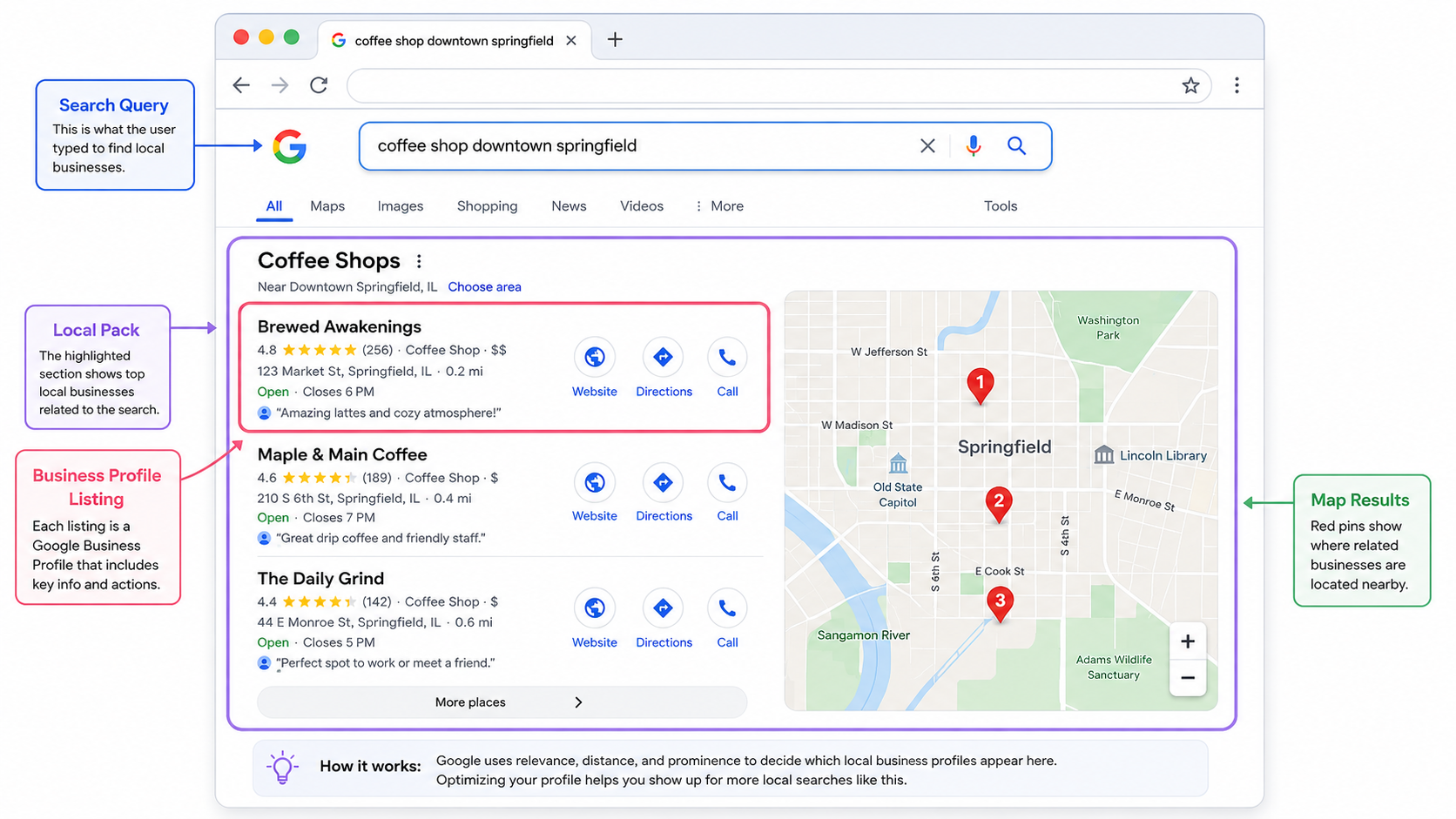
In the example image, the search for a coffee shop produces three nearby businesses and corresponding map pins. The highlighted listing represents a Google Business Profile, while the full outlined section represents the local pack.
Google primarily considers relevance, distance, and prominence when deciding which businesses to show. A complete Business Profile, accurate categories, recent reviews, consistent business details, and a strong local reputation can improve a business's ability to appear. However, location still matters, so two people searching from different neighborhoods may see different results.
Organic Search Results
Organic results are the standard webpage listings that appear outside the map pack. They may include a local business website, service page, location page, directory, news publication, or locally relevant guide.
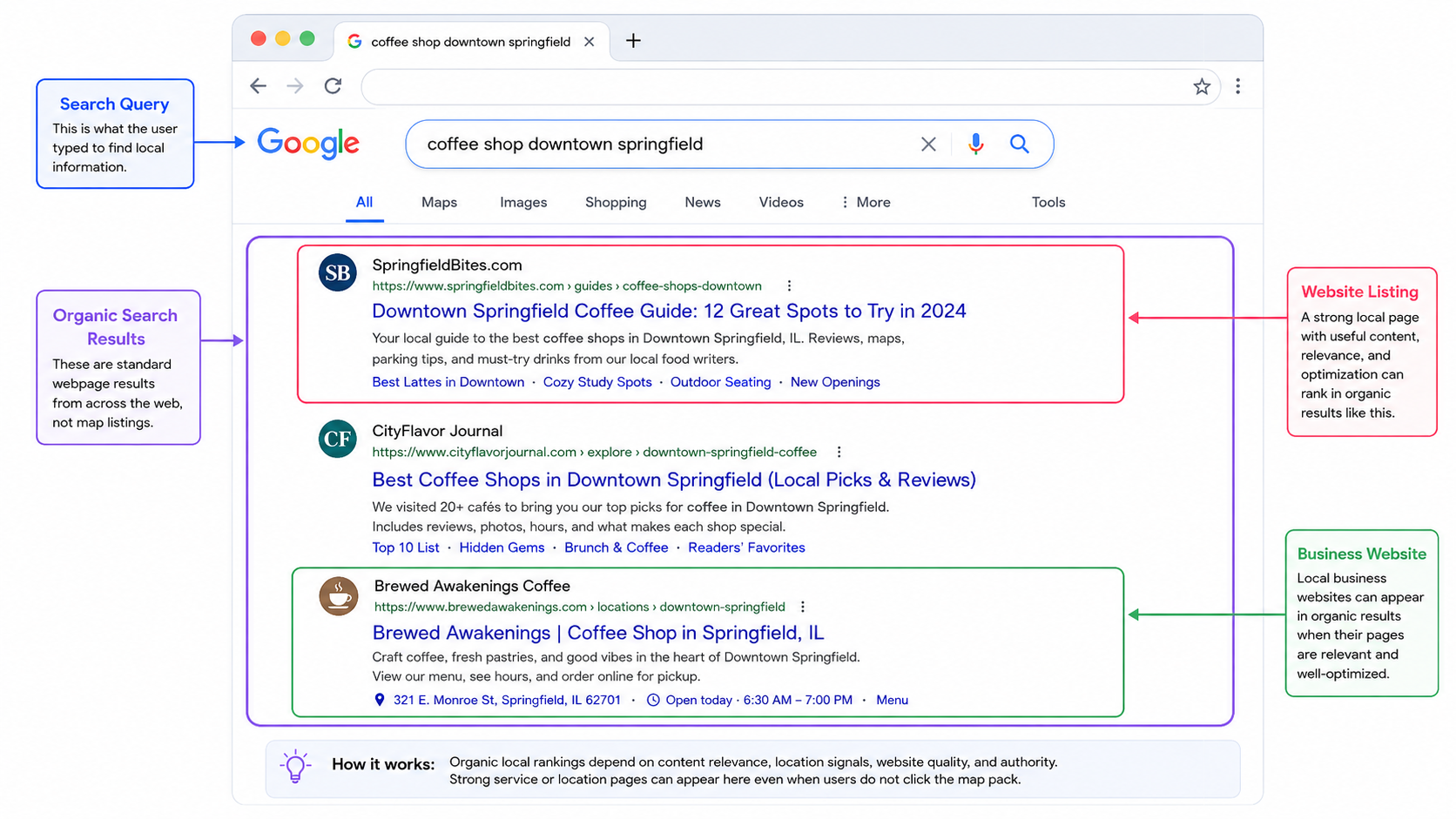
In the second example, the results include two local guides and the website of an individual coffee shop. This demonstrates that a business does not only compete against nearby companies. Its website may also compete with directories, review platforms, publishers, and other websites targeting the same local search.
A business website is more likely to appear in local organic results when it has:
- A page that directly matches the searched service and location
- Useful, original information that answers the searcher's needs
- Clear location and service-area signals
- Strong titles, headings, internal links, and technical foundations
- Relevant backlinks, citations, and local authority
- A fast, mobile-friendly experience with clear conversion options
For example, a well-developed page targeting "coffee shop in Springfield" may appear organically even when the business is not selected for the map pack. This gives businesses more than one opportunity to reach the same customer.
How Is Local SEO Different From Traditional SEO?
Traditional SEO and local SEO both aim to improve visibility in search results, but they target different audiences and buying behaviors. Traditional SEO helps a website compete across broader regional, national, or international searches. Local SEO focuses on helping nearby customers find and choose a business in a specific city, neighborhood, or service area.
The two approaches are not completely separate. Local SEO still depends on strong traditional SEO foundations, including useful content, mobile performance, technical health, and authority. The difference is that local SEO adds location, proximity, listings, reviews, and local relevance to the strategy.
How to Do Local SEO?
Local SEO works best when every part of a business's online presence supports the same message: what the business offers, where it operates, and why customers should trust it. That requires more than creating a Google Business Profile. A complete local SEO strategy also includes keyword research, local pages, reviews, accurate listings, on-page improvements, and local authority.
1. Audit Your Current Local Visibility
Start by identifying where the business already appears and where it is losing opportunities.
Review the Google Business Profile, existing rankings, customer reviews, directory listings, service pages, location pages, mobile performance, and conversion tracking. This creates a clear starting point and helps prioritize the issues most likely to affect calls, bookings, visits, and enquiries.
2. Research the Businesses Already Ranking
The businesses appearing in the local pack and organic results are the real search competitors, even if they are not the companies you usually consider direct competitors.
Compare their:
- Google Business Profile categories
- Review quantity and recency
- Services and products
- Service and location pages
- Page titles and headings
- Local links and mentions
- Photos, offers, and calls to action
The goal is not to copy competitors. It is to identify what they do well and where they leave gaps that your business can fill.
3. Optimize Your Google Business Profile
A complete and accurate Google Business Profile helps Google understand the business and gives customers the information they need to take action.
Add or review:
- Business name
- Primary and secondary categories
- Address or service area
- Phone number and website
- Opening and holiday hours
- Services and products
- Business description
- Booking or appointment links
- Original photos and videos
All information should match the real business. Avoid adding unnecessary keywords to the business name or creating profiles for locations that do not qualify.
4. Find High-Intent Local Keywords
Local keyword research should focus on the searches most likely to lead to a call, booking, visit, or quote request.
Start With Core Services
List the main products and services customers may search for. For example:
- Emergency plumber
- Commercial roofing
- Dental implants
- Google Ads management
Add Relevant Location Terms
Combine those services with genuine geographic targets such as cities, neighborhoods, counties, and service areas. Examples include:
- Emergency plumber in Dallas
- Commercial roofing company in Austin
- Dentist near me
- Google Ads agency in Chicago
Not every local search includes a place name. Google can still detect local intent from queries such as "coffee shop" or "emergency plumber."
Use Google Autocomplete and Related Searches
Google Autocomplete, People Also Ask, related searches, Maps categories, and competitor pages can reveal how customers describe their needs.
Look for:
- Service variations
- Cost questions
- Comparison terms
- Urgent searches
- Common customer concerns
- Neighborhood and city modifiers
Confirm Local Search Intent
Before targeting a keyword, search it and study the results.
If Google shows a map pack, local businesses, location pages, or directories, the query likely has local intent. If the results are mostly national guides or ecommerce pages, a different content format may be more appropriate.
Check Search Volume and Commercial Value
Search volume can help compare opportunities, but it should not be the only deciding factor. A highly specific local term with modest volume may generate more revenue than a broader keyword with thousands of low-intent searches.
Assign Keywords to the Right Pages
Each important keyword group should have a clear destination.
| Search type | Best page |
|---|---|
| Core service | Service page |
| Service plus city | Local service or location page |
| Business name or directions | Homepage or Google Business Profile |
| Cost, process, or comparison question | Article or guide |
| Multiple services in one city | Location hub page |
Avoid creating several pages that target the same service and location. That can cause pages to compete with each other.
5. Build Useful Service and Location Pages
A local page should do more than repeat a city name. It should help customers understand the service, confirm that the business serves their area, and make the next step easy.
Strong pages may include:
- Detailed service information
- Genuine service-area details
- Local projects or case studies
- Customer testimonials
- Original photos
- Team or office information
- Pricing factors
- Common questions
- Clear calls to action
For multi-location businesses, each eligible location should have a distinct page with accurate information and local proof. Avoid duplicating the same copy across dozens of cities.
6. Correct and Expand Your Local Listings
Local listings and citations mention the business's name, address, phone number, website, or other identifying details.
Prioritize platforms that customers and search engines actually use, including:
- Major map and search platforms
- Industry directories
- Local chambers
- Professional associations
- Trusted regional websites
Correct outdated information, remove duplicate listings, and keep core business details consistent. The aim is not to appear in hundreds of low-quality directories. It is to make the business information dependable wherever customers encounter it.
7. Generate and Manage Customer Reviews
Reviews help customers compare local businesses and provide current evidence that a business is active and trusted.
Create a consistent process to:
- Ask satisfied customers for honest feedback
- Share a simple review link
- Respond to positive and negative reviews
- Monitor review recency
- Identify recurring complaints or praise
- Avoid buying or incentivizing reviews
Responses should be helpful and natural. Repeating the same keyword-heavy response under every review can make the business appear automated and untrustworthy.
8. Improve On-Page and Technical Local SEO
The website should clearly communicate the business's services, locations, and next steps.
Improve:
- Page titles and headings
- Service and location relevance
- Internal links
- Contact information
- Mobile usability
- Page speed
- Indexing and crawlability
- Structured business data
- Calls to action
- Call, form, and booking tracking
These improvements support rankings, but they also make it easier for visitors to become customers.
9. Earn Local Links and Community Mentions
Backlinks are more useful when they also strengthen local credibility.
Potential opportunities include:
- Local publications
- Chambers of commerce
- Professional associations
- Suppliers and business partners
- Community organizations
- Relevant sponsorships
- Local events
- Original regional studies or resources
A smaller number of genuine local links and mentions can be more valuable than many unrelated links from low-quality websites.
10. Keep Your Local Presence Updated
Local SEO is not a one-time setup. Business information, competitors, customer expectations, and search results continue to change.
Regularly update:
- Hours
- Services
- Locations
- Staff information
- Photos
- Reviews
- Local pages
- Directory listings
- Conversion tracking
The strongest local SEO campaigns improve continuously based on rankings, customer behavior, leads, and revenue rather than relying on one-time optimization.
What Is a Good Local SEO Strategy?
A good local SEO strategy focuses on the actions most likely to improve visibility, generate qualified leads, and increase revenue in the locations a business actually serves. It should not treat every task as equally important or rely on rankings alone.
The right approach depends on the business model, competition, number of locations, current reputation, and condition of the website. A single-location clinic, a service-area contractor, and a national franchise may all use local SEO, but they should not follow the same plan.
A strong strategy usually follows three stages:
1. Fix the Foundation
Start with the issues that can prevent the business from appearing or converting customers:
- Incorrect or incomplete Google Business Profile information
- Wrong business categories
- Duplicate or inconsistent listings
- Missing service and location pages
- Poor mobile performance
- Weak calls to action
- No call, form, or booking tracking
Fixing these problems creates a reliable foundation before investing in content, links, or broader expansion.
2. Build Relevance and Trust
Once the foundation is stable, strengthen the signals that connect the business with its services and locations.
This may include:
- Improving core service pages
- Creating useful location pages
- Publishing answers to common local customer questions
- Collecting and responding to reviews
- Adding original photos, projects, and case studies
- Earning relevant local links and mentions
- Keeping business information current
The goal is to show both customers and search engines that the business is active, credible, and genuinely connected to the market it wants to serve.
3. Measure Leads and Improve What Works
A good local SEO strategy should be guided by business results, not only keyword positions.
Track:
- Local pack and organic visibility
- Google Business Profile interactions
- Calls, forms, bookings, and direction requests
- Qualified leads by service and location
- Lead-to-customer conversion rates
- Revenue generated from local search
Use this data to decide which services, locations, pages, and campaigns deserve more attention.
For most businesses, the strongest strategy is to dominate one genuine market before expanding into additional cities. Building dozens of thin location pages may create more URLs, but it rarely creates the relevance, trust, or customer experience needed for sustainable growth.
Not sure which local SEO improvements will have the biggest impact? Pinnacle can review your website, local presence, and competitors to identify the fastest opportunities for growth.
See where your business really stands
Tell us about your business and we’ll review your website, local presence, and competitors to find the fastest opportunities for growth.
How Local SEO Increases Profits?
Local SEO increases profits by placing a business in front of nearby customers who are already searching for its services. These searches often lead directly to calls, bookings, quote requests, directions, and store visits.
It can improve profitability by:
- Generating more high-intent leads
- Increasing visibility without paying for every click
- Building trust through reviews and accurate business information
- Improving conversion rates with stronger local pages
- Helping the business compete in its most valuable service areas
The real value comes from converting local visibility into customers. Rankings matter, but calls, appointments, closed sales, and customer value are better measures of success.
A simple way to estimate the impact is:
Local leads × close rate × average customer value = estimated revenue
For example, 30 qualified leads with a 20% close rate and an average customer value of $1,500 could produce approximately $9,000 in revenue.
The essential tools businesses use to improve local visibility, track performance, and find growth opportunities.
How Much Does Local SEO Cost?
Local SEO may be priced as a monthly retainer, a one-time project, or a per-location service. Lower-cost packages often cover basic profile and listing work, while larger campaigns may include content, technical SEO, local link building, and lead tracking.
Pricing is commonly affected by:
- Number of locations and service areas
- Condition of the website and Google Business Profile
- Local competition
- Citation and listing problems
- Content and location page requirements
- Review management
- Link building and local outreach
- Reporting and conversion tracking
The better question is not only how much local SEO costs, but whether it generates enough qualified customers to justify the investment. At Pinnacle Technologies, our local SEO specialists clearly explain what is included, how success will be measured, and how each part of the strategy connects to leads and revenue.
Should You Hire a Local SEO Company?
A local SEO company is most useful when your business is already investing in local visibility but lacks a clear plan, consistent execution, or reliable measurement.
The right partner should help you identify where leads are being lost, prioritize the markets with the strongest potential, and turn search visibility into measurable business growth. This is especially valuable in competitive markets, for multi-location businesses, or when internal teams do not have the capacity to manage local SEO consistently.
Choose a company that is transparent about its process, reports on leads and revenue, and gives you full ownership of your profiles, data, and accounts.
Conclusion
Local SEO still works because it connects businesses with nearby customers at the moment they are ready to call, visit, book, or buy. The strongest results come from combining an optimized Google Business Profile with useful local pages, accurate listings, customer reviews, strong website performance, and consistent tracking.
The goal is not simply to rank higher. It is to make the business easier to find, trust, and choose.
Local SEO Questions
Why Is Local SEO Important to Your Business?
Local SEO is important because it helps nearby customers find your business when they are ready to call, book, visit, or buy. It improves visibility in Google Maps, the local pack, and organic results while building trust through reviews, accurate listings, and relevant local content.
How Do You Do a Local Listing in SEO?
To create a local listing for SEO, claim your Google Business Profile and add accurate business information, including your name, address, phone number, website, hours, services, and categories. Then keep the same details consistent across trusted directories, industry platforms, and local business websites.
How Can You Improve Local SEO Rankings?
Improve local SEO rankings by optimizing your Google Business Profile, earning recent customer reviews, creating useful service and location pages, correcting inaccurate listings, building relevant local links, and improving website performance. Track both Maps and organic results because local visibility can vary by neighborhood and searcher location.
What Are the Most Effective Local SEO Tips?
The most effective local SEO tips are to choose accurate Business Profile categories, keep business information current, target high-intent local keywords, publish original location content, respond to reviews, improve mobile usability, and track calls and bookings. Focus on genuine relevance rather than keyword stuffing or creating duplicate city pages.
What Is Local Listing Management?
Local listing management is the process of creating, updating, and monitoring business information across Google, maps, directories, review platforms, and industry websites. It helps prevent incorrect addresses, outdated phone numbers, duplicate profiles, and inconsistent details that can confuse customers and weaken local search visibility.
Is Local SEO Worth It?
Yes, local SEO is worth it for businesses that serve customers in specific cities, neighborhoods, or service areas. It can generate qualified calls, bookings, visits, and enquiries without paying for every click. Its value should be measured through leads, customers, and revenue rather than rankings alone.